
Gmail Reputation Data Is Dead. Now What?

Gmail Reputation Data Is Dead: Email Verification for Deliverability Is the New Sender Playbook
It was never really the score that mattered. It was what the score approximated. For years, sender reputation data was the closest thing to a predictable signal for inbox placement. ESPs, blacklist operators, and third-party monitoring tools aggregated bounce rates, complaint rates, and spam-trap hits into a number that email teams watched like a stock ticker. If the number dipped, panic. If it stayed high, confidence.
That model is breaking down. Gmail no longer gives third-party tools enough observability to make those scores predictive. The new Gmail sender requirements are simpler, more transparent, and far less forgiving. As a result, email verification for deliverability has become the most practical way to protect your sender reputation before Gmail’s compliance checks ever see a bad address.
In this article, I’ll walk through what changed in Gmail’s enforcement, why legacy sender-reputation tools are losing relevance, and how modern email verification for deliverability can keep your SaaS campaigns out of the spam folder. We’ll also dig into temporary email reputation risk, SaaS email list hygiene, and the operational routines that actually survive platform policy shifts.
The Shift: What “Gmail Reputation Data Is Dead” Actually Means
The New Gmail Sender Requirements and What Changed

In late 2023, Google updated its bulk email sender guidelines and announced enforcement beginning in February 2024. The headline changes are:
- Authentication is mandatory. Bulk senders must have SPF, DKIM, and DMARC configured for their sending domains.
- Spam rates must stay below 0.10%. Google calculates this from reports in Postmaster Tools.
- Unsubscribes must be easy. One-click unsubscribe headers, as described in RFC 8058, need to be honored within two days.
Notice what is absent from this list: no mention of “reputation score,” “IP age,” or “domain age.” Google has moved from opaque reputation judgments to concrete, binary thresholds. That is a seismic shift.
Legacy reputation data companies built predictive models from historical engagement and complaint signals, but they can’t see Gmail’s internal spam-report rate. They can estimate, but the estimate is no longer precise enough to make proactive decisions.
Why Legacy Sender-Reputation Tools Are Losing Signal
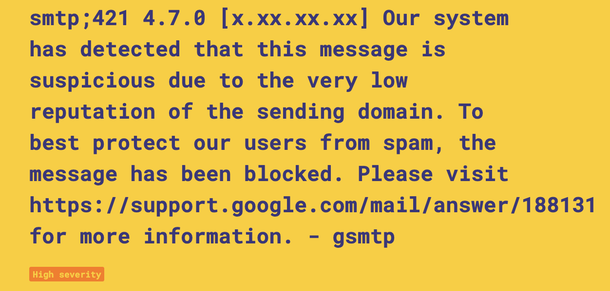
.png)
A sender-reputation score was always an approximation of future behavior. It was useful because delivery outcomes were correlated with historical signals. But that correlation decays when the underlying platform changes.
Consider what happened when Gmail increased the importance of spam complaints and decreased the importance of IP reputation. Senders with pristine IP history but sloppy signup flows suddenly hit the 0.10% spam threshold. Their old reputation score said “safe,” but Gmail’s compliance check said “not safe.” The external data didn’t update fast enough to reflect the new reality.
In practice, that means a team could watch a reputation dashboard stay green for four straight quarters while their promotional emails quietly drift into Promotions, then Spam, then nothing. That is not a reputation failure by the old definition. It is a data staleness failure.
What This Means for SaaS Senders and Email Marketers
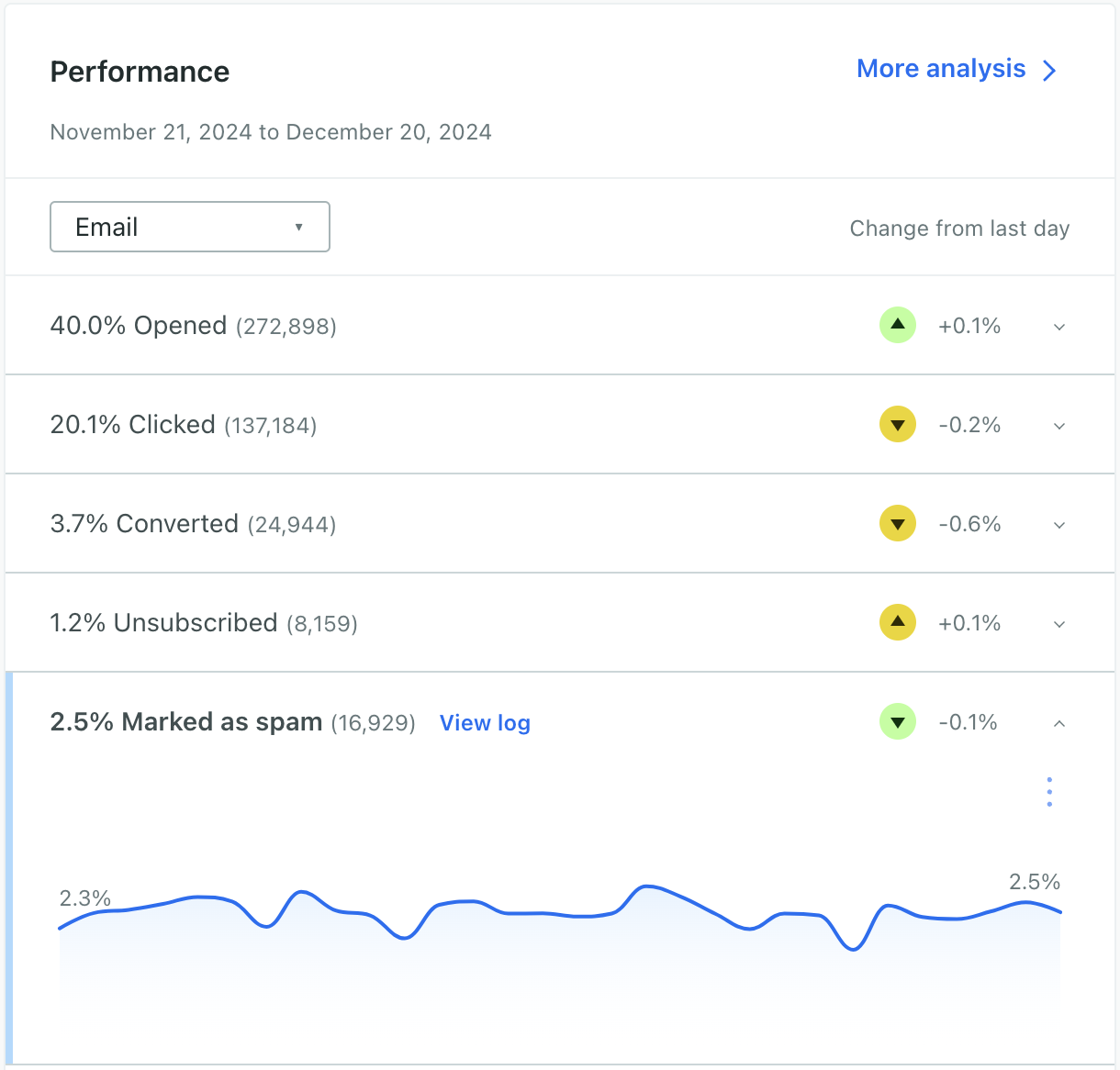
For SaaS teams, this is personal. Subscription-driven businesses rely on high-volume sends to revenue-generating segments. They also have the messiest signup flows, full of trial accounts, guest checkouts, and lead-magnet downloads. That mix attracts disposable and invalid addresses.
The practical response is to stop treating reputation as something you monitor and start treating it as something you engineer through list quality. That means moving from “watch the score” to “verify the address before it ever gets the chance to hurt you.” Email verification for deliverability is no longer a nice-to-have; it is the new reputation system.
Email Verification for Deliverability: Your New Post-Reputation Playbook
Why Email Verification for Deliverability Matters More Than Score Watching
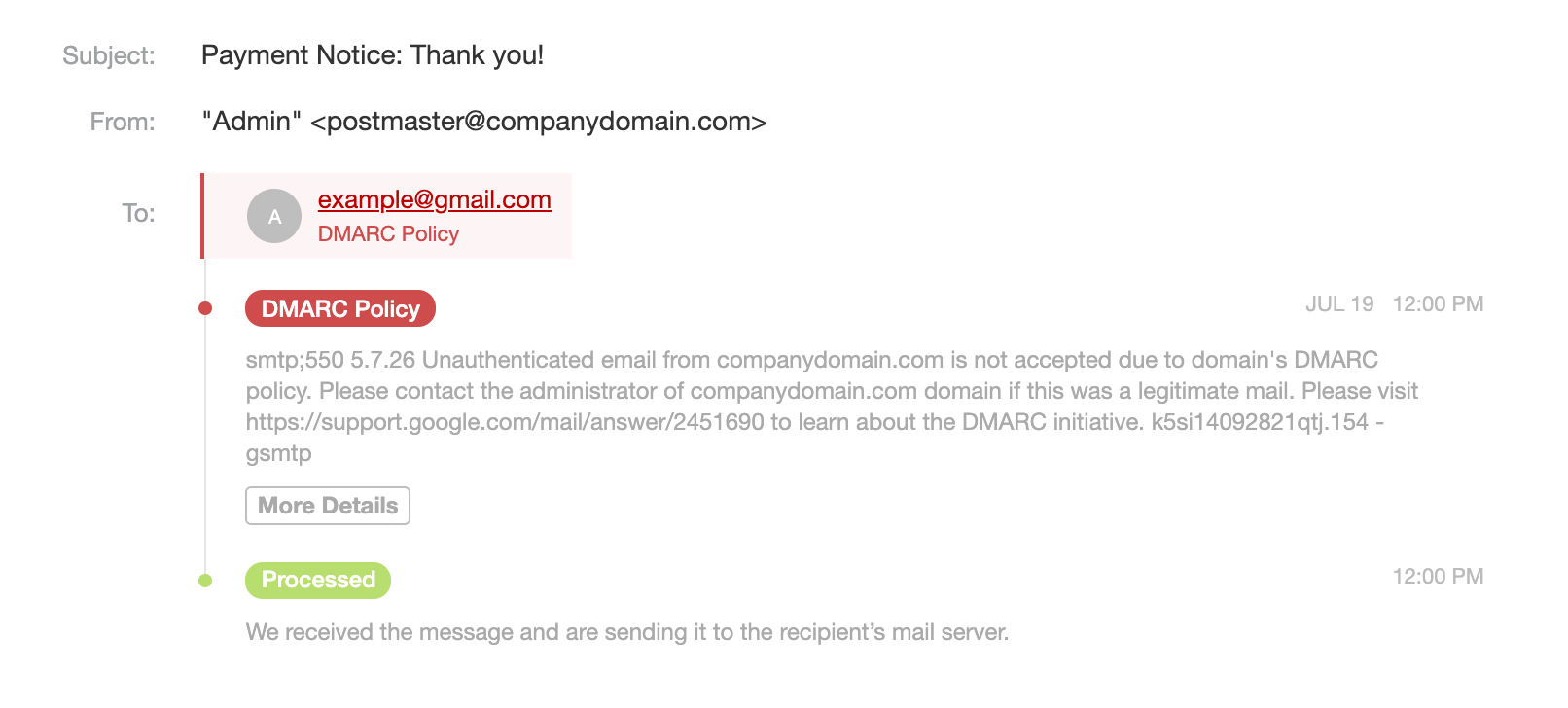
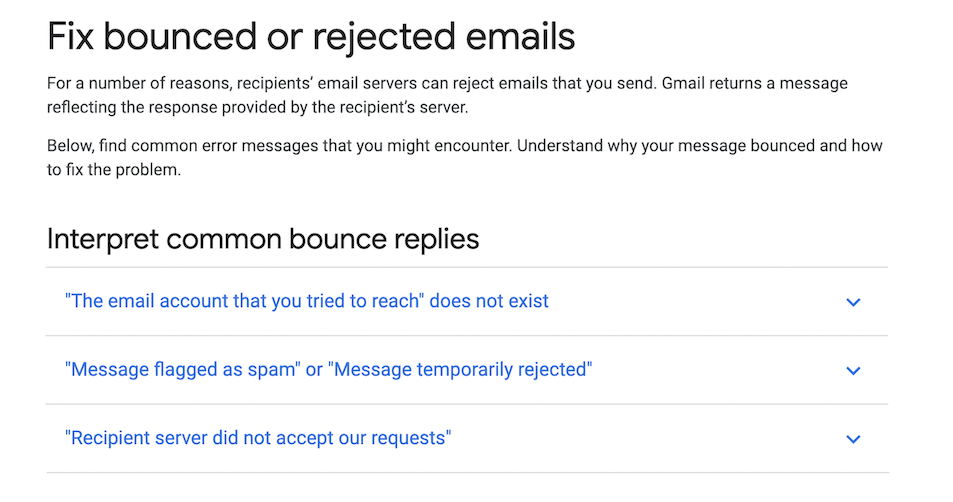
Let’s be precise: bounce rate is no longer a direct Gmail compliance metric in the way spam rate is. But bounces still matter because they feed complaint mechanisms and spam-trap networks. Invalid and disposable addresses can distort every signal you use to measure sender quality.
The logic is simple. If 10% of your list is invalid, those emails will generate a certain number of bounce events. If you use legacy SMTP analytics tools, those bounces are invisible until after the send cap. But when those same invalid addresses start appearing on spam-trap lists, your domain’s trust in Gmail’s eyes drops quickly. That’s why email verification for deliverability must happen before you queue the campaign.
From an operations standpoint, verification also cleans your metrics. Every invalid address you remove means your open rate is calculated on a truly reachable audience. Your click-through rate reflects real human intent, not an automated mailbox. That is the kind of data you can make business decisions on.
Under the Hood: How Modern Email Verification Works
Modern email verification is a multi-layer process. It begins with syntax validation against RFC 5322, which catches obviously malformed addresses. Next, domain validation checks whether the domain has DNS A or MX records. Then a deeper layer uses SMTP conversation checks to determine whether a specific mailbox is accepting mail.
This is where intelligent verification diverges from a binary valid/invalid response. A temporary email domain may have perfectly valid MX records. A catch-all domain may accept all mail regardless of whether individual addresses exist. To identify those, you need risk scoring.
This is what Mailgun’s email validation documentation refers to as risk assessment. Instead of a simple valid versus invalid, a scoring engine assigns a probability that an address is risky, along with the reasons for that score. For example:
{
  "email": "tmp.user@mailinator.com",
  "verdict": "risky",
  "reasons": [
    "temporary_email_domain",
    "recent_domain_creation"
  ],
  "score": 0.94
}
AntiTemp’s explainable risk scores take this one step further by showing the why behind the number. The score is not a black box; it’s a decision-grade data point your engineering team can use in automation rules, audit logs, and deliverability reports.
Integrating Real-Time Email Verification at Signup
The best place to improve list quality is at the point of capture. When a user submits a signup form, a real-time verification API can evaluate that address in milliseconds. AntiTemp’s API returns sub-500ms responses, which means the verification is invisible to your user but instantly actionable to your system.
A common mistake is to only verify email addresses during batch cleaning or before a major campaign. By then, the damage is often already done: welcome emails have bounced, spam traps have activated, and Gmail’s spam rate has moved in the wrong direction. Real-time verification flips that around.
With real-time checks at signup, you can allow a legitimate user through, flag a suspicious address for review, or block a known disposable domain before it ever enters your activation flow. That single integration pays for itself by preventing the downstream costs of failed sends and inbox placement problems.
Temporary Email Reputation Risk: The Hidden Threat in Your SaaS List
How Temporary Emails Create Reputation Risk Even After Gmail’s Shift
Temporary email addresses are not just a nuisance. They are a distinct category of risk that doesn’t respond well to standard email validation. These are domains set up specifically for one-time use, often with no long-term owner. They are designed to pass syntax and domain checks.
A useful analogy is using a burner phone number for a store loyalty program. You get the coupon, but the store has no way to contact you later. In email terms, the store also gets a handful of metrics that look good in the first 48 hours — perhaps a confirmation open, maybe a welcome click — then everything goes dark.
That pattern is exactly what reputation risk looks like. If a significant segment of your list is temporary, Gmail’s engagement algorithms see low long-term engagement from those addresses. More importantly, disposable email domains are often harvested by spammers and placed on suppression lists. Send to them and you risk the same spam-trap exposure that dirty shared IPs used to cause.
We call this temporary email reputation risk because it behaves differently from ordinary invalid data. Invalid addresses fail loudly; disposable addresses fail quietly, and they keep failing until your reputation has already been affected. Disposable email address providers rotate domains quickly, so a static blocklist is never enough. You need a verification engine that recognizes the pattern of disposable domains, not just a list of known bad domains.
Real-World Example: A Temporary Email Reputation Risk Skewing Campaign Data
Let me walk through a scenario that will sound familiar to any SaaS deliverability manager.
A B2B SaaS company has 80,000 active subscribers on its main product newsletter list. An audit reveals that about 8% of those addresses are from known temporary email providers. That is 6,400 low-quality contacts. The lifecycle team has been confused for months because their conversion emails show a 35% open rate but a 0.2% conversion rate.
The math is ugly. Those 6,400 temporary addresses inflate the open rate by maybe 4 percentage points, but they are also generating unsubscribe requests and spam reports at a higher rate than real users. Gmail’s spam rate threshold is 0.10%. One bad campaign to that entire list can push the domain over the edge.
After the team integrated AntiTemp and quarantined those addresses before the next send, their spam-report rate dropped, their engagement metrics became clearer, and future campaigns moved back to a stable inbox placement. The result was not a magic reputation fix; it was a systematic removal of the factors that were producing bad signals.
Batch Processing and Risk Scoring: Cleaning Up Existing Lists
Real-time verification is ideal for the signup flow, but what do you do with a list that has been growing without verification for years? That’s where batch processing fits in.
With batch verification, you submit a list of email addresses to an API and receive risk scores for each address asynchronously. AntiTemp’s 95%+ accuracy and explainable scores give you decision-grade data for segmentation. You can decide: keep the clearly valid addresses, quarantine the risky ones, fix addresses that have a recoverable typo, and discard those with a high temporary email reputation risk score.
Batch processing is an important clean-up step, but don’t think of it as a one-time project. It is the second phase of a recurring hygiene cycle.
SaaS Email List Hygiene: A Practical Framework for the Post-Reputation Era
Building a SaaS Email List Hygiene Routine Around Verification Data
Email list hygiene is not a project; it’s a cadence. A simple, effective routine looks like this:
- Verify every new address at signup using real-time API verification.
- Re-verify your active list before every major campaign or every 30 days, whichever comes first.
- After each send, automatically suppress addresses that bounced, complained, or were flagged as risky by your verification system.
- Export the removed addresses and add them to your suppression list to avoid sending to them again.
When you follow this routine, SaaS email list hygiene becomes the operational backbone of your deliverability strategy. You are not waiting for signals from Gmail. You are producing clean signals on your side of the pipe.
When to Use (and Not Use) Batch Verification
Batch verification works well for historical lists, data appends, and segments assembled from third-party sources. It is also useful when you want to re-score an entire list after your verification vendor updates its temporary-domain database.
But batch verification is not sufficient for ongoing signup-flow management. If you only clean your list on a monthly schedule, you’re still allowing a month of bad data to flow into your engagement metrics. A user who signs up on the first day of the month stays in your system for 30 days, receives welcome communications, and may trigger complaints before the next batch check.
That’s why the combination of real-time API verification and periodic batch checks is the most effective pattern. Real-time handles the inbound flow. Batch handles the accumulated historical noise.
Pros and Cons: Always-On Verification vs Periodic Cleaning
The table below summarizes the tradeoffs between always-on real-time verification and periodic batch cleaning, as they relate to sender reputation and operations.
| Approach | Strengths | Weaknesses | Best for |
|---|---|---|---|
| Real-time at signup | Fastest protection, prevents bad data from entering, protects campaign metrics | Requires integration work, adds API cost per signup | SaaS signup flows, lead capture forms |
| Periodic batch cleaning | Good for one-time historical cleanup, easier to plan | Leaves a window for bad data to accumulate, requires another process | Legacy list audits, seasonal re-verification |
| Hybrid | Protects new data and cleans old data continuously | More moving parts to maintain | Any serious sender |
If you are an early-stage SaaS team with limited engineering time, start with real-time verification at signup and use a batch run before your first big campaign to clean existing records. That one-two punch is enough to prevent the most common reputation-damaging scenarios.
Common Pitfalls and Lessons from Production
Mistakes That Still Destroy Inbox Placement
Even with good tools, senders make predictable mistakes. Here are the ones I see most often in production:
- Ignoring temporary email domains because the addresses look technically valid. If an address passes syntax and MX checks but comes from a disposable provider, it is still a liability.
- Cleaning lists too late. The optimal time is before things break, not after. By the time your reputation metrics or Gmail’s spam rate has moved, the damage is already being measured.
- Relying solely on engagement metrics. Engagement is a lagging indicator. By the time unsubscribe rates climb or spam reports appear, Gmail’s compliance bucketing has likely already been affected.
- Not integrating verification with your email service provider. If your verification system is separate from your ESP, you end up with manual exports, slow adoption, and missed opportunities.
Lessons from Production: What Actually Works
Teams that maintain high inbox placement share a few habits. They treat verification not as a marketing utility but as a data-quality system. They define what a “risky” address means for each segment, and they build automation to act on those definitions. They also value explainability.
In practice, explainability matters more than raw accuracy. When a verification API simply returns “invalid,” you cannot defend the decision. When it returns “risky because this domain is a known temporary email provider and was created four days ago,” you can build business rules around it. This is why anti-temp explainable risk scores are not just a feature; they are a governance tool.
One lesson we keep seeing across senders using Mailgun, SendGrid, Amazon SES, and Postmark is that teams who set up automated suppression after every send have a far easier time maintaining a low spam rate. The send is the moment of truth. If you wait until the aftermath to review your list, you are already on the back foot.
What the Experts Say About the Future of Sender Reputation
The broader deliverability community has largely converged on a nuanced view: sender reputation is not dead as a concept, but it is dead as a proactive strategy. You can’t manipulate your reputation directly. You can only manipulate the inputs: authentication, list quality, engagement, and compliance.
Because Gmail’s sender requirements are now transparent and threshold-based, the most reliable way to stay under the spam-rate limit is to prevent spam complaints before they happen. That requires knowing exactly what is in your list, why each address is there, and whether it poses a risk. In other words, verification has become the new reputation insurance.
Future-Proofing Your Deliverability Strategy
Moving from Reputation Data to Real-Time Email Verification
The shift in mindset is from monitoring to verification. A reputation dashboard tells you what happened last week. A real-time verification API tells you what to do in the next 500 milliseconds. That is a fundamentally different type of insight.
Email verification for deliverability becomes a continuous system when you integrate it into the signup flow, the campaign preparation process, and the post-send feedback loop. It is no longer a one-time cleanup job. It is a practice.
How AntiTemp’s Explainable Risk Scores Support Long-Term Deliverability
SaaS teams need visibility over every address in their ecosystem. That means low-latency checks for inbound signups, high-volume batch checks for list refreshes, and a uniform risk language across both. AntiTemp delivers on this by combining real-time API verification with batch processing and explainable scoring.
The emphasis on explainability is important. When your deliverability team can see that a user was blocked because their email came from a high-risk temporary domain, they can make more informed decisions about whether to reach out to that user through an alternative channel. The score becomes a piece of business intelligence, not just a spam filter.
The Bottom Line for SaaS Teams
If you take one thing away from this article, make it this: stop watching Gmail reputation data as if it were a weather forecast and start treating email verification for deliverability as your operational reality. Audit your current risk profile. Verify all new addresses at signup. Re-verify existing lists on a recurring cadence. Suppress risky addresses after every send. Then monitor your deliverability results.
SaaS email list hygiene is not the most glamorous part of email marketing, but it is the durable competitive advantage in an era of platform policy shifts. The teams that invest in verification infrastructure now will not just survive the next Gmail change — they will have an inbox placement advantage that no reputation dashboard can provide.